
Fun Tennis Drills for Kids Ages 5–8
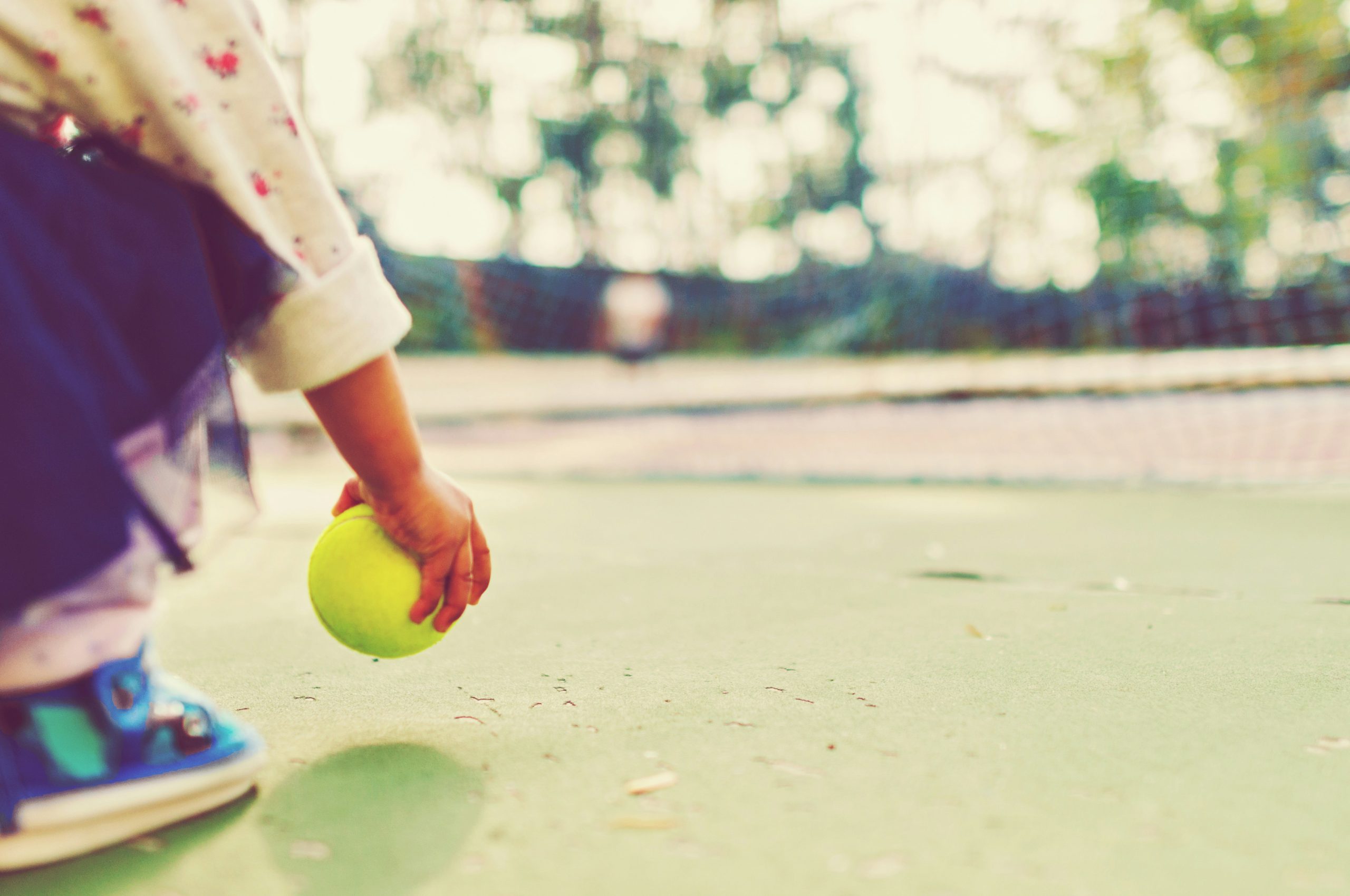
For beginners ages 5 to 8, a strong starting point is scaled tennis: slower red balls, a smaller playing area, a racket the child can control, and simple activities that create frequent chances to contact the ball. USTA youth guidance uses this type of scaled setup, and research generally supports matching tennis equipment and court size to beginning players rather than starting with adult conditions. The early goal can be simple control: sending a ball toward a target and gradually building toward a short rally.
These tennis drills for kids move from basic ball and racket control to self-fed hits, parent feeds, targets, and cooperative red-ball rallies. The sequence is flexible. Age is only a starting point because size, coordination, attention, confidence, disability, prior experience, and individual development can all affect which version fits.
Quick Start: Equipment and Setup for Ages 5 to 8
The United States Tennis Association, or USTA, uses scaled equipment for youth tennis. Its current guidance starts beginners with red foam or felt balls and a 36-by-18-foot red court. The USTA describes red balls as slower and lower bouncing than standard yellow balls. Its 2026 rules require red-ball tennis in sanctioned 8-and-under tournaments and use a 36-foot court for that format. USTA Perfect Match USTA Friend at Court 2026
Research supports the broader idea of scaling tennis to the player, although it does not establish one perfect setup for every child. Piquer-Piquer and colleagues’ 2025 scoping review in Frontiers in Psychology mapped 35 empirical studies of modified tennis equipment involving children, novice adults, players with disabilities, and coaches. The review reported generally favorable findings for control, technique, game performance, and engagement, but the studies varied substantially in populations and methods, and the authors identified gaps in participant diversity and longer-term, real-game research. Piquer-Piquer et al., 2025
| Setup | Good starting point | Adjust when… |
|---|---|---|
| Ball | Red foam or felt ball | A foam ball can make an early task easier. A child already controlling red-ball rallies may be ready to try a harder variation. |
| Racket | A child-sized racket that feels manageable | The racket looks difficult to control or the child struggles to position it for contact. |
| Playing area | 36-by-18-foot red court or a smaller marked area | Frequent misses suggest shortening the distance. Easy control may support a little more space. |
| Net | Red-court net, portable net, or simple dividing line for informal practice | A net becomes more obstacle than useful game feature. |
| Session | Short, active blocks with frequent hitting | Attention, fatigue, weather, or family logistics make a shorter session more appropriate. |
A driveway or another flat area can work for informal practice when it is clear of traffic and other hazards. USTA youth guidance specifically notes that tennis can be played at home on a flat, safe surface, so a formal tennis court is useful but not required for these drills.
Seven Tennis Drills for Kids That Build Toward a Rally
The sequence below is a practical progression rather than a scientifically validated seven-step program. Each activity removes or adds a particular challenge. When a drill is too difficult, the useful response is usually to simplify the task rather than add more instructions.
1. Roll and Stop
Parent and child start a few feet apart and roll a red ball back and forth through a wide lane or between two cones. At first, the child can stop the ball with a hand. The next version uses the racket face to stop or gently redirect it.
This removes the difficulty of judging a bounce while introducing direction and racket-face control. A single cue such as “strings toward the target” is enough.
If the ball regularly misses the lane, shorten the distance or widen the gate. If the activity becomes easy, narrow the gate or ask the child to receive the ball on alternating sides.
2. Balance and Tap the Ball on the Strings
Place a red ball on the racket strings and see whether the child can keep it balanced. Next, try one gentle upward tap and catch, then two taps, then several in a row.
The practical purpose is simple racket-face control. It does not need to look like a tennis stroke.
A foam ball can make the task easier. A child who already controls several taps can try alternating sides of the racket or walking slowly while balancing the ball. Personal-best challenges can add interest, but the number should remain a game rather than a test of ability.
3. Bounce, Tap, Catch
The child drops the ball, lets it bounce, taps it upward or slightly forward with the racket, then catches it. Once that is manageable, the sequence can become bounce, tap, tap, catch.
This introduces timing between a bounce and racket contact without requiring a second player to send a difficult incoming ball.
If the drop itself creates trouble, a caregiver can provide a predictable drop. A harder version sends the ball after one bounce through a wide cone gate.
4. Self-Drop Hit to a Big Target
The child stands close to a large target area, drops the ball, lets it bounce, and hits it toward the target. A wide cone gate, chalk box, or section of court gives the hit a clear purpose.
Self-feeding allows the child to control when the ball arrives. Early success can mean simply making contact and sending the ball generally toward the target. A large backswing, topspin, or adult-looking finish is not necessary for the activity to work.
Once contact becomes reliable, the target can become narrower or slightly farther away. Only one difficulty should change at a time.
5. Gentle Parent Feeds
The caregiver now sends predictable underhand tosses or very gentle racket feeds toward a comfortable contact point. Start on one side and leave enough time between balls for the child to reset.
When several feeds in a row produce poor contact, the feed is the first thing to adjust. Slower, closer, and more predictable feeds often make the task clearer than adding several technical corrections.
As control improves, the caregiver can introduce a small amount of movement and later alternate sides. The feeder should remain outside the child’s swing path and use a controlled speed.
6. Cone Gates and Target Zones
Place two cones several feet apart and ask the child to send the ball through the gate. Another version marks a large landing zone on the other side of a line or net.
Targets shift attention toward what the ball does rather than how the swing looks. The gate should begin wide enough to make success realistic. It can become narrower as control improves.
Families can count how many balls reach the target or work together toward a shared total. There is no need to deduct points for misses. A miss simply gives information about whether distance, target size, feed, or racket control needs adjustment.
7. Cooperative Red-Ball Rally
The final step is the part that begins to look like tennis. Parent and child stand close together on a short court and try to keep a red ball going after one bounce.
A first target might be two or three contacts. The adult’s job is to return a hittable ball, not win the point. As the rally becomes more reliable, the pair can increase the distance or aim for a longer exchange.
When rallies repeatedly break down, the child has not failed the progression. The activity can temporarily return to predictable feeds, or a catch-and-hit step can bridge the gap between a feed and a continuous rally.
Rally length is useful for tracking a particular child’s practice. It is not a developmental benchmark that every child should reach by a particular birthday.
How to Progress the Drills Without Making Them Too Hard
The simplest progression changes one variable at a time. A parent can make an activity harder by increasing distance, shrinking a target, making a feed less predictable, adding movement, or asking for more consecutive contacts.
That order matters less than watching what happens after a change. If contact largely disappears, the activity probably became too difficult for that moment. The previous version remains useful.
A practical adjustment sequence is:
- Distance: Start close and add space gradually.
- Target size: Begin with a large landing area or wide gate.
- Feed predictability: Keep early feeds slow and similar before adding variation.
- Movement: Add a step or two only after stationary contact is manageable.
- Consecutive contacts: Move from one successful hit toward a short rally.
- Ball and court: Progress the equipment only when the current setup no longer provides enough challenge.
This approach is consistent with the broader evidence for scaled tennis, but there is no research-backed success percentage that determines when every child should progress.
Children also differ in how instructions are easiest to process. A visual target or quick demonstration may be more useful than verbal explanation for some children. Others may respond well to one short cue. These differences should not be used to infer a learning style, diagnosis, or developmental problem.
A Repeatable 20 to 30 Minute Parent-Child Tennis Session
A short session can combine the drills without trying to fit all seven into every practice. The following 20-to-30-minute format is a practical example, not a developmental standard.
- 3 to 5 minutes: Move and roll. Use Roll and Stop or a simple throw-and-catch activity while moving around the small court.
- 4 to 5 minutes: Racket control. Choose balancing, tapping, or Bounce, Tap, Catch.
- 6 to 8 minutes: Hitting. Move from self-drop hits to predictable parent feeds.
- 4 to 6 minutes: Target game. Use cone gates or a large landing zone.
- 3 to 5 minutes: Cooperative rally. Finish with the most tennis-like exchange the child can currently manage.
The clock is less important than the quality of the activity. A 10-minute session can make more sense when attention is fading, the weather is uncomfortable, or the family simply has less time.
Explanations should stay brief. One cue followed by several attempts usually keeps more of the session focused on playing. When an activity is producing frustration or repeated misses, making the task easier is a reasonable first adjustment.
For outdoor play, families should account for weather and have water available. The hitting area should provide enough space for a racket swing without another person, wall, vehicle, or hard obstacle inside the swing path. Play should stop if a child reports pain, feels dizzy, is injured, or otherwise appears unwell.
What Parents Should Coach, and What They Can Leave Alone
A tennis-playing parent may see many technical details that could be corrected. A young beginner does not need all of them at once.
Early parent-led practice can focus on observable outcomes: tracking the ball, contacting it, sending it toward a target, moving back into position, and keeping an exchange going. When a technical cue helps solve one of those problems, it can be short and specific.
A demonstration can also replace a long explanation. After the cue or demonstration, the child needs opportunities to try the task rather than a correction after every ball.
Praise can stay specific to what actually happened, such as persistence after a miss, a longer rally, or better control of the target. This article does not assume that a particular style of praise guarantees motivation or confidence.
Family practice also does not need to become formal coaching. When instruction repeatedly creates conflict, the child wants more structured technical help, or the family is moving toward competitive tennis, a qualified youth coach may be a better person to handle technique. Family tennis can remain the place where parent and child simply play together.
When to Move Beyond Red-Ball Beginner Drills
USTA’s 2026 rules require red-ball tennis in sanctioned 8-and-under tournaments. In sanctioned 10-and-under competition, the USTA uses orange or green ball tennis. Red uses a 36-foot court, orange a 60-foot court, and green a full 78-foot court. Those are competition rules, not a requirement that recreational players change equipment on a birthday. USTA Friend at Court 2026
For informal family play, functional readiness is more useful than racing through colors. Signs that the current setup may be getting too easy include comfortable racket control, reliable contact with the red ball, movement toward incoming balls, and the ability to sustain a simple rally.
Near the upper end of the 5-to-8 age range, some children may be ready to experiment with orange-ball activities. Others may benefit from red-ball conditions longer. Faster progression is not inherently better.
Formal lessons become useful when a child wants structured technical development, peer practice, or competition, or when a parent wants individualized guidance on equipment and progression.
Safety, Limitations, and When to Get More Help
These drills are recreational activities, not a way to assess motor development or treat a coordination problem. Ordinary beginner misses, awkward swings, and short rallies do not establish that a child has a developmental concern.
The basic safety priorities are straightforward: use a clear playing area, keep the feeder and other people outside the swing path, use controlled feeds, account for weather, and stop play when pain, injury, dizziness, or another safety concern occurs.
If concerns about coordination are broad, persistent across activities, or already causing concern outside tennis, a pediatrician or another qualified professional can help determine whether further evaluation is appropriate. Tennis drills should not be used as a diagnostic test.
Recurring pain or injury also falls outside the scope of a general tennis article. A qualified health professional can provide individualized guidance. A youth tennis coach is the more appropriate resource for technique, competitive progression, or a parent-child coaching dynamic that is no longer working well.
Frequently Asked Questions (FAQs)
Sources
- United States Tennis Association. Friend at Court 2026: Handbook of Rules and Regulations. USTA, 2026. Current USTA regulations define red-ball tennis on a 36-foot court, orange-ball tennis on a 60-foot court, and green-ball tennis on a 78-foot court. The regulations require red ball in sanctioned 8-and-under tournaments and orange or green ball in sanctioned 10-and-under tournaments. Official handbook.
- United States Tennis Association. Perfect Match. Current youth-equipment guidance, accessed August 2026. Describes red foam or felt balls as slower and lower bouncing than standard yellow balls, a 36-by-18-foot red court, shorter youth rackets, and progression to orange and green/yellow formats. It also notes that informal tennis can be played on a flat, safe surface. This is governing-body guidance rather than an independent effectiveness study. Official guidance.
- Piquer-Piquer, Ana, Miguel Crespo, Jesús Ramón-Llin, José Francisco Guzmán, and Rafael Martínez-Gallego. “Exploring the impact of equipment modifications on novice tennis players: a scoping review.” Frontiers in Psychology, 2025;16:1536427. DOI: 10.3389/fpsyg.2025.1536427. Scoping review of 35 empirical studies found through Web of Science, Scopus, PubMed, SPORTDiscus, expert input, and reference searching. Included primarily young players ages 6 to 14, plus novice adults, players with disabilities, and coaches. It mapped technical, tactical, biomechanical, psychological, and coaching outcomes. Important limitations include heterogeneous populations and methods, limited participant diversity, and gaps in longer-term and real-game evidence. Full text.
- Farrow, Damian, and Machar Reid. “The effect of equipment scaling on the skill acquisition of beginning tennis players.” Journal of Sports Sciences, 2010;28(7):723-732. DOI: 10.1080/02640411003770238. Five-week study of 23 inexperienced 8-year-old players comparing scaled and standard conditions. Outcomes included rally volume, stroke proficiency, hitting opportunities and success, enjoyment, and commitment. The small, short-duration sample limits broad generalization. PubMed record.
- Buszard, Tim, Machar Reid, Rich S. W. Masters, and Damian Farrow. “Scaling Tennis Racquets During PE in Primary School to Enhance Motor Skill Acquisition.” Research Quarterly for Exercise and Sport, 2016;87(4):414-420. DOI: 10.1080/02701367.2016.1216653. Five-week primary-school study of 46 children ages 6 to 7, with 23 using a smaller racket and 23 a larger racket. The smaller-racket group improved forehand and backhand technique more, but hitting-performance outcomes were similar. The authors noted limited practice opportunities. PubMed record.


